
Agentic Platforms
Not Just Another Buzzword

If you Google “Agentic Platforms” you will see lists of lists of best platforms and it’s the .ai sites that create those (go figure). But what are they and why is this yet another hype?
Agentic platforms are AI systems that manage autonomous agents capable of reasoning, planning, and executing multi-step tasks. Think of it as a "virtual employee" - you train it, tell it what to do and it does it based on the knowledge you've shared with it. Simple as that.
Some people argue that agents are just orchestration and automation renamed to something cooler. However, what's truly different is that the AI underneath can actually reason. It doesn't just follow a script, it interprets messy, real-world inputs, decides what to do next, and adjusts when things don't go as planned.
The “Virtual Employee” Analogy
The framing is pretty accurate actually. AI agents do work 24/7, handle data traffic spikes without extra headcount and can speed up business processes by 30-50% in areas from finance and procurement to customer operations. BCG
Higher-level “orchestrator” agents act like project managers that break processes down into subtasks, while task agents execute individual steps and send results back. Bain & Company
And Who’s Building This?
Everyone (basically)! Leading software vendors including Microsoft, Salesforce, Google, and IBM are fuelling large-scale implementation by embedding agentic AI capabilities directly in their platforms. MIT Sloan The broader trend is vendors shifting from add-on AI features to integrated multi-agent platforms embedded in core workflows and data layers. Futurum Group
Real-world results are starting to show:
Capital One built an agentic tool for auto dealership customers that is 55% more successful at converting customer engagement. Fortune
A South American bank uses agents to facilitate payments through WhatsApp: customers just describe what they want to pay and the agent then interprets, confirms, and authorizes the transaction. Bain & Company
So… Why the Skepticism?
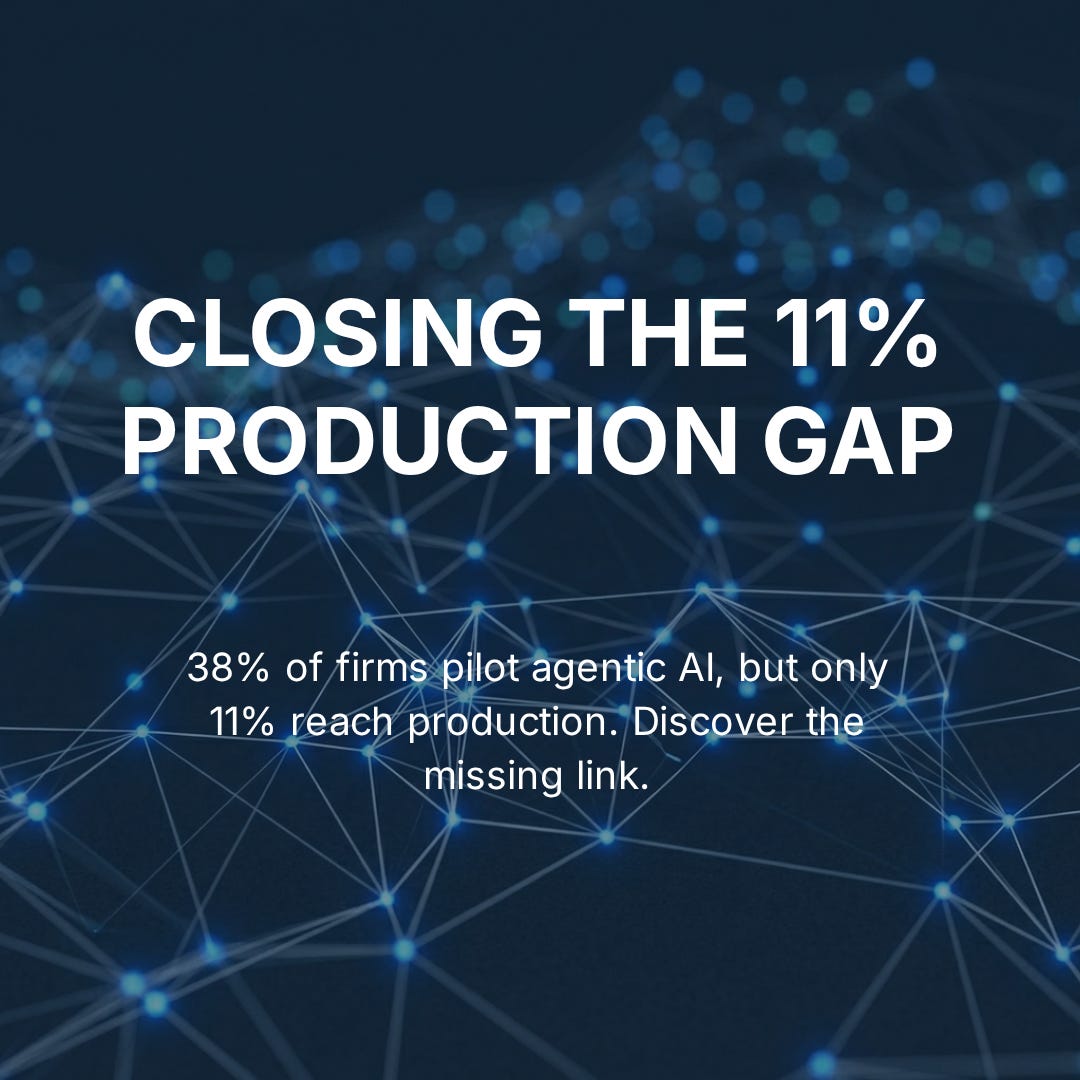
Because the gap between pitch and production reality is still wide. While 38% of organizations are piloting agentic solutions, only 11% are actively using them in production. Deloitte Insights In November 2025, the Wall Street Journal reported that few companies deploying AI agents have received a return on investment. Wikipedia
Gartner predicts that over 40% of agentic AI projects will fail by 2027 because legacy systems can’t support modern AI execution demands. Deloitte Insights
! And it is very important to note that the underlying work is harder than it looks. Great effort in deploying AI agents goes to data engineering, stakeholder alignment and governance, not the AI itself !
Where Is This Going?
Gartner predicts that 15% of daily work decisions will be made autonomously by agentic AI by 2028, up from essentially 0% in 2024, with 33% of enterprise software applications expected to include agentic AI by then. Deloitte Insights
That’s not a trend, my friend, that’s a structural shift in how work gets done.
The honest advice for businesses: start narrow and make it measurable. Pick one well-defined workflow, build something real, and validate before buying into the grand vision. Agentic platforms have genuine potential but they reward thoughtful adoption, not hype-chasing.
Interested in how agentic AI fits into your software development roadmap? Explore how Scopic approaches AI-powered solutions here.