
AI vs. Automation
Are You Paying a Premium for a Buzzword?

We live in a world where “AI” has become the answer to every business problem, whether the question was actually asked or not. Boards demand it. Vendors sell it. And somewhere in the middle, business owners are signing six-figure contracts for solutions that, frankly, could have been solved with a well-configured workflow and a fraction of the budget.
Let’s slow down for a second and talk about what’s actually going on.
The Confusion Is Not New
When the first industrial revolution reshaped economies, people feared machines would take over everything. But even amid that disruption, there was a clear logic to it: manual processes moved to mechanized ones. The change was visible, tangible, and (in retrospect) appropriately matched to the problem it was solving. Nobody installed a steam engine to do the work of a pencil.
Today, we’re in a similar moment of technological anxiety and excitement. The difference is that the distinction between tools is far less visible and that’s being exploited.
AI and Automation Are Not the Same Thing
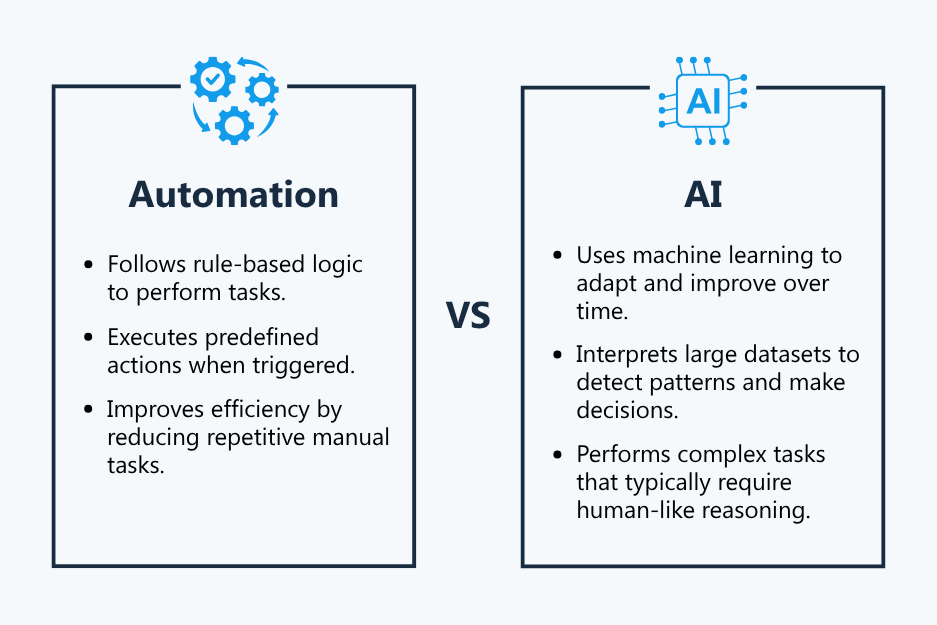
Automation is the use of technology, software, or systems to perform tasks with minimal human intervention. Think of scheduled email sequences, invoice processing, data entry pipelines, rule-based chatbots, or inventory alerts. These are predictable, repeatable processes and there is mature, affordable technology that handles them reliably.
AI, on the other hand, involves systems that learn, adapt, and make decisions based on patterns in data. It’s genuinely powerful for problems involving unstructured data, complex prediction, natural language understanding, or dynamic decision-making at scale.
The problem? “AI” sounds better in a pitch deck. It signals innovation. It justifies a higher price tag. And so vendors slap the label onto tools that are, at their core, straightforward automation (and charge accordingly...)
Why This Matters for Your Business
If your goal is to stop manually copying data between two systems, you do not need a machine learning model. You need an integration. If you want to send follow-up emails based on user behavior, you do not need a large language model. You need a well-built automation sequence.
Buying AI when automation would do the job is not just expensive: it introduces unnecessary complexity, longer implementation timelines, and maintenance overhead that grows over time. The ROI simply isn’t there.
But it goes the other way too. There are genuine use cases where automation won’t cut it: dynamic customer personalization at scale, extracting meaning from thousands of unstructured documents, predicting churn before it happens. For those, AI isn’t a luxury - it’s the right tool.
The real question is: do you know which camp your problem falls into?
Start With the Problem, Not the Technology
Before you respond to any proposal make sure you’ve first mapped what you’re actually trying to achieve. What is the bottleneck? Is it repetitive and rule-based, or does it require judgment and adaptability? What does success look like in measurable terms?
That clarity is what separates smart technology investments from expensive ones.
This Is Exactly What We Help With at Scopic
At Scopic, we start every engagement with an honest evaluation of where your business actually stands. Our AI consulting services are built around identifying whether AI genuinely creates value for your specific context, or whether a simpler, faster, and more affordable automation approach will get you to the same outcome.
We offer AI readiness assessments, proof-of-concept research, and end-to-end implementation. And we will tell you when you don’t need any of that yet. That’s a conversation worth having before you commit your budget.
If you want a no-pressure starting point, book a free consultation with our team here. Come with your challenge, we’ll help you figure out the right tool for it.